


Agricultural Law Conference Guides Maryland Farmers Through Uncertain Times
Farmers, legal scholars, environmentalists, and state officials gathered in Annapolis on Nov. 10 for the 2025 Agricultural and Environmental Law Conference, where discussions centered on building resilient local food systems.
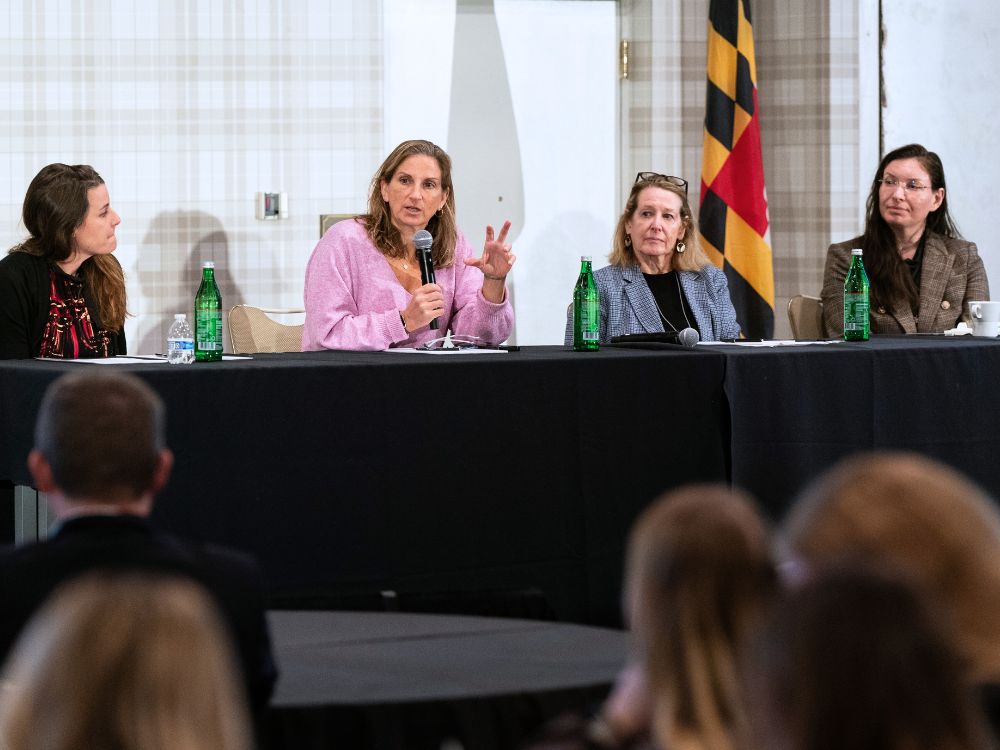
Left to right, Erin Duru, Del. Lorig Charkoudian, Nancy Nunn, and Megan Todd discussed food security in Maryland at the 2025 ALEI Conference.
During a pre-lunch address at the conference hosted by the University of Maryland Agriculture Law Education Initiative (ALEI), Renée Laurent, JD, dean of the University of Maryland Francis King Carey School of Law, acknowledged the challenges farmers face as they scramble to keep up with policy shifts affecting everything from global trade to SNAP benefits to climate-smart agriculture grants.
“It’s dizzying imagining how hard it would be to keep up with changes,” Laurent said. “That highlights just how really critically important the work of ALEI is.”
The conference is an annual highlight for ALEI, a University of Maryland Strategic Partnership: MPowering the State (MPower) initiative that is a collaboration of Maryland Carey Law; the College of Agriculture & Natural Resources (AGNR) at the University of Maryland, College Park; and the School of Agricultural and Natural Sciences at the University of Maryland, Eastern Shore. Launched in 2013, ALEI’s mission is to educate and serve Maryland family farmers by providing expert information and training on complex legal issues such as estates and trusts, regulatory compliance, and farm food safety.
Maryland’s Agricultural Priorities
In his keynote speech, Maryland Secretary of Agriculture Kevin Atticks outlined three priorities for Maryland agriculture. Conservation is paramount, he said, adding that the state’s Department of Agriculture will launch the Leaders in Environmentally Engaged Farming Program in 2026 to encourage farmers to increase conservation practices.
Agricultural literacy and food system resiliency round out the priorities, particularly relevant given recent SNAP benefit disruptions that caused payment delays and uncertainty for the 42 million Americans relying on nutrition assistance. Atticks pointed to lessons from the COVID-19 pandemic, when supply chain failures left grocery stores empty while local farmers had abundant food.
Atticks noted improvements require changing the law. “It’s changing our food system, little tweaks here and there, like 20 percent buying local here, or one more school system decides to buy local there. It’s decoding what they need.”
Farmers and Food Security
Megan Todd, JD, senior research associate and managing director of ALEI at Maryland Carey Law, moderated a food security panel that explored the impact of federal policy changes as well as state and local solutions. She noted that over 600,000 Maryland residents who receive SNAP benefits were thrown into a period of nutritional uncertainty when benefits were disrupted during the federal government shutdown.
“This is a very timely topic, not just because of the work that we’ve been doing, but for many other unfortunate reasons,” Todd said. “This situation that we have is truly unprecedented.”
The panel featured Erin Duru, assistant director of Maryland’s SNAP-Ed program; Nancy Nunn, assistant director of the AGNR Harry R. Hughes Center for Agro-Ecology; and Del. Lorig Charkoudian, District 20, Montgomery County, a longtime advocate for local food access and farm-to-school programs.
Through a Sustainable Agriculture and Education grant, Todd's team has provided technical assistance to help 26 Maryland farmers navigate the complex process of becoming authorized SNAP vendors. The work addresses both market access for farmers and food security for low-income residents.
“Farmers that I work with are truly invested in their communities,” Todd said. “They’re truly invested in the idea of helping to make the people in their community healthier, and that also comes with the benefit of supporting their business.”
Charkoudian asked attendees how many were familiar with the Certified Local Farm and Fish Program enacted in 2022. A few raised their hands. “It seems like such an obvious idea that’s taken years and years,” she said of the program she described as a “work in progress.”
The program is designed to increase economic participation of Maryland farms and seafood processors by requiring state agencies to purchase 20 percent of food from farms meeting Maryland nutrient management standards. If they don’t use Maryland farmers, agencies must provide justification.
“We’re forcing the conversation,” she said, noting that Maryland farmers have been boxed out of state procurement because they weren’t part of international distribution chains. “Now we’re able to talk to a farmer who didn’t get the contract, and it was because the sizes of the eggs didn’t work for the prison system. So now we can start to look at the prison system rules about egg size and say, ‘Do we really need that rule?’ ”
A Farmer’s Perspective
VK Holtzendorf, owner of Red Top Farm and an 11-year conference attendee, emphasized the connection between food assistance programs and farm viability. Her 13-acre farm in southern Anne Arundel County specializes in winter greens.
During the pandemic, when her restaurant clients were shuttered, Holtzendorf provided produce to a local church food pantry. Police directed traffic as cars lined up for the distribution.
“They were gone in an hour, and we just had no idea the demand,” she said.
Holtzendorf noted that SNAP program disruptions create a ripple effect throughout the agricultural community.
“When you threaten cuts, not only do you hurt the people who are using the SNAP benefits, but the farmers, too,” she said.
Other panels addressed pressing farming and environmental issues including transmission line development across agricultural land, riparian buffers, solar energy expansion, Maryland’s new heat illness prevention standard and federal appropriations for USDA programs.
Paul Goeringer, JD, MS, LLM, AGNR principal faculty specialist and extension specialist, provided a comprehensive 2025 agricultural and environmental law update with an eye on changes coming in 2026. He discussed recent state right-to-farm rulings, evolving PFAS (so-called “forever chemicals” that build up in the environment and may be linked to certain health issues) litigation and regulation, and key legislative changes impacting agriculture.
MPowering the State
Laurent praised ALEI’s ability to support Maryland agriculture through uncertain times.
“By working together, our impact is so much larger than any of us working alone,” she said. “This partnership helps us to do that.”
The MPower partnership has enabled the law school to expand clinical programs, host specialized events, and offer courses on agricultural law. Laurent noted particular success with the Brinsfield internship program, now in its seventh year, which assisted the Maryland Farm Bureau with local food procurement research during summer 2025.
“It is very important for us that we create that next generation of ag lawyers who will spend their careers helping farmers,” she said.\